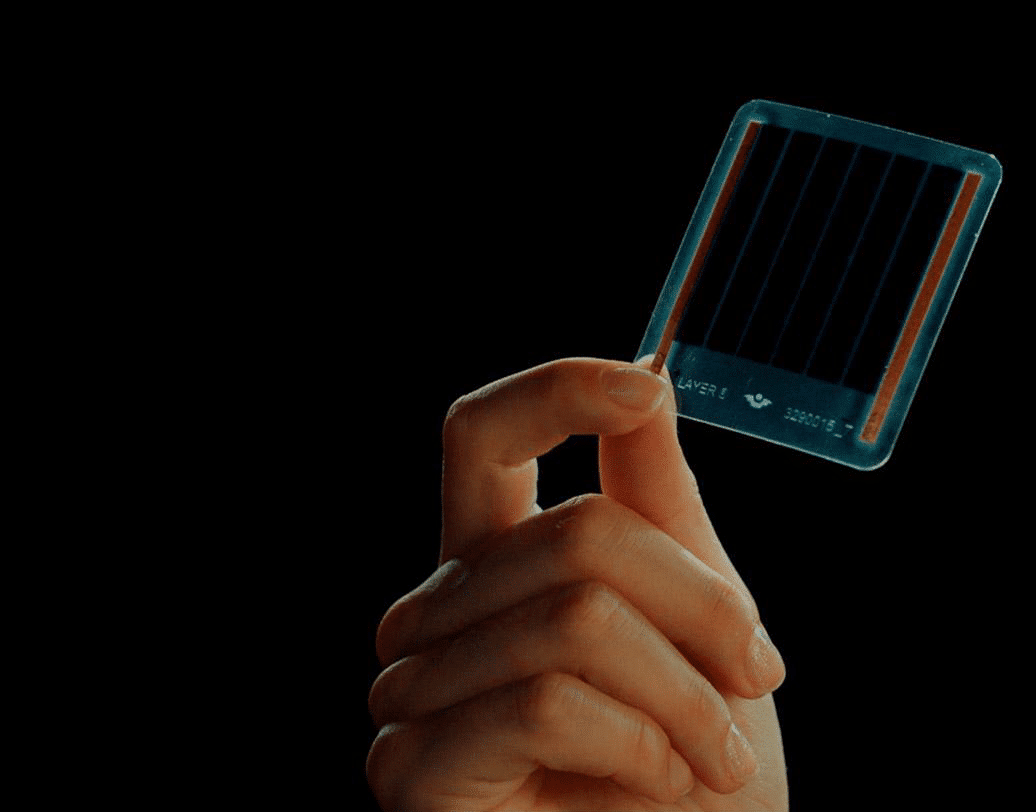
OPV-Powered Smart Cards: How Indoor Light and Ultra-Slim Supercapacitors Can Eliminate Battery Waste
As smart cards become more sophisticated, integrating displays, sensors, dynamic authentication modules, and even microprocessors, the challenge of powering them in a sustainable manner has become increasingly urgent.
Most advanced cards today rely on thin lithium batteries, either primary or rechargeable cells, embedded inside the laminated structure of the card.
Products containing lithium batteries face strict transportation regulations, which significantly increase shipping complexity, costs and traceability administration, for example with a digital passport.
Producing and recycling lithium batteries consumes substantial energy and generates non-negligible environmental impacts.
In most smart cards, the battery is inaccessible and cannot be replaced. Once depleted, the entire card must be discarded and manufactured again or designed with a charging interface, which adds cost and reduces efficiency.
A typical smart card is expected to last up to 15 years, yet an internal primary cell battery often lasts less than two. As a result, a single user may go through 7–8 cards, discarded solely because their embedded battery ran out of power, unless the card is designed with a rechargeable battery requiring charging hardware, increasing repairability index. Still, this will create significant electronic waste and increases the carbon footprint.
For example, an ultra-thin rechargeable battery with smart-card-compatible dimensions (55.5 × 22.5 × 0.5 mm), such as the GRP0422055, can deliver approximately 333 joules of total stored energy (4.2 V × 22 mAh).
A typical smart card requires around 0.068 J per activation, meaning this battery supports only ≈4,897 activations in ideal conditions.
Given that users activate their cards 5 to 60 times per day, the battery lifetime ranges between:
This is far from the 15-years expected lifetime for a modern smart card.
Organic photovoltaics (OPV) offer a promising and sustainable solution.
These ultra-thin, flexible solar cells can be seamlessly integrated into the card and harvest energy even under low-intensity indoor lighting. Over a 15-year period, under typical indoor illumination 200 lux for 10 hours per day a 10.5 cm² OPV module can produce:
5.775 Wh, equivalent to 20,790 joules, provided the OPV cell is properly biased, which corresponds to ≈ 63 times the energy stored in the 22 mWh battery mentioned earlier.
The biasing aspect of the PV cell is non-negligible. The PV cells alone do not provide the maximum energy that they can produce. To obtain the maximum performance under given lighting conditions, it is recommended to bias them using a maximum power point tracking method, and this can be perfectly performed with an energy harvesting Power Management Integrated Circuit (PMIC). The use of PMICs is now common practice. It is also well understood that in normal case conditions, PV-lighting will evolve by several orders of magnitude, inducing huge variations of PV power generation capability, and this can be continuously tracked and managed by the PMIC.
This power output enables the smart card to function even under heavy usage for up to 14 years, without relying on a conventional disposable lithium cell. Instead , energy storage can be provided by an ultra-slim supercapacitor, which is smaller, safer, and rated for over 100,000 charge cycles. Again, optimum use of the supercapacitor is provided by the PMIC which is in charge not only to prevent the supercapacitor from being over charged but also to monitor when the application can be supplied with an optimized source voltage.
The role of the supercapacitor is critical as OPVs alone cannot cover every scenario. Smart cards must remain fully functional for days or weeks without or with lower exposure to light. To maintain essential security functions during these dark periods, the card must include a backup energy storage. Ultra-slim supercapacitors are ideal for this purpose as:
With a properly dimensioned OPV surface, a PMIC and a thin supercapacitor, the card’s energy reserve is expected to never fully deplete, enabling a single card to last 14+ years instead of being replaced every 1–3 years due to battery exhaustion. And in case of extreme storage conditions, PMIC will enable faster and reliable cold start.
We believe such implementation represents a sustainable breakthrough for the smart-card industry, as it dramatically reduces electronic waste, simplifies logistics and shipping (no lithium restrictions), lower carbon emissions and far more sustainable product to the field.
OPV-powered smart cards with integrated ultra-slim supercapacitors and PMIC represent a practical, clean, and scalable evolution in secure, connected card technology—powering devices with nothing more than everyday indoor light.