


After 35 years in the electronics industry, Bruno Damien has learned to tell the difference between an innovation that moves things forward and one that pulls them back. “They are a source of progress as well as catastrophic regressions,” he says of the technologies he has watched roll out — cellular phones, high-speed connectivity, the internet, AI. It is the kind of judgment you might expect from someone trained in the French preparatory classes (Mathématiques Supérieures and Spéciales), then an engineering school, then a DEA in Quality and Reliability of electronics — a degree, he notes with quiet pride, that he still uses almost every day, most recently to guide e-peas through its ISO 9001 and ISO 14001 certifications.
Today, Bruno is Ecosystem and Partners Director at e-peas, a fabless semiconductor company with a mission he states without hedging: “to revolutionise the industry by shifting the world to green renewable energy devices. Our target is to eradicate the use of disposable batteries wherever possible, using energy technologies.“
The scale he cares about is not the one you see on rooftops. “Everyone knows the black solar panels sitting on roof-tops or the field of white windmills in the countryside (I admit they are looking bad) — we focus on more tiny implementations like for powering Remote Control Units, PC keyboards, Electronic shelf labels, and Smart card or Wearable devices like in Effector. Credit card size gives a good idea for the scale of our focus.“
At the heart of EFFECTOR’s system sits e-peas’ core product: the Power Management Integrated Circuit, or PMIC. Bruno describes its role with the precision of someone who has spent decades thinking about how energy moves through a circuit. The PMIC does three things at once: it biases the organic solar cell so it delivers maximum power whatever the lighting conditions; it charges and discharges the supercapacitor within safe limits; and it powers the application — EFFECTOR’s smart-card and wearable demonstrators — only once the source and storage are stable. “We make sure each element is working in the best conditions with highest reliability, independently of one each other.”
For Bruno, this is not just engineering — it is an ecosystem problem. “It is an amazing fact to see that in our ultra-connected working environment, disciples are highly clustered. Effector project allows to break the walls and close the gaps.” He extends the same logic to regulation: e-peas watches battery waste management rules across the US, India, China and Europe, because the technology only matters if the policy environment lets it land.
Ask Bruno what innovation means, and you get something you will not find in a corporate brochure. “Innovation is the answer of living-beings to the evolution and changes of their ecosystem. Innovation as an engine of life evolution by the means of natural species ‘selection’ as supposed by Ch. Darwin, but also driven by our human brain (I would not say intelligence).”
He is not sentimental about it. “It is difficult to rate if innovation is always positive. I would say much less than 100% of innovations are positive in fact.” What tips the balance for him is consequence: “what we do here is certainly compensating for the disastrous effect of disposable batteries on Nature and land fields. It is not the only solution but this one that can (and is) fast adopted in the field, together with recycling initiatives and a better use of Earth’s natural resources.”
In EFFECTOR, that translates into a concrete target: “Effector is defining and implementing alternative solutions to the old AA, AAA, CR2032 paradigm, without compromising on performance of electronic devices.” Reducing pollution, slowing the eutrophication of resources, cutting the risk of accidental fires from IoT batteries — and, for the devices people carry on their bodies, something more ambitious still: “Those devices are attached to and worn by human beings. We are working to make them energy autonomous so they can work forever.”
Bruno is clear that EFFECTOR addresses only part of the problem — the “edge” in networked architectures, the small devices closest to the user. But he is equally clear that the bigger energy story is elsewhere: “The backbone is mostly invisible, hidden, but its energy appetite is every day bigger in overall energy demand of mankind. It is obviously not sustainable as-is.”
He goes further, naming the unease that many feel but few in semiconductor companies will voice: “Post-Humanism and Trans-humanism are really knocking at our daily life with so many AI fake characters / videos and mails. But energizing this whole remains a main unknown. Questions about Ethics and Ethical developments are also recurring.”
Ask about his hobbies, and the semiconductor executive gives way to something else entirely. Summer sailing on a Hobie Cat. Archaeology — “on paper, not yet in practice.” The evolution of species and humankind. Civilisation development. History of science. Music.
Then he lists what he calls his “Vertigos” — the questions that make him dizzy:
La folie mathématique / La biologie échappe-t-elle aux mathématiques ? (Alain Finkielkraut, France Culture, 2025)
La physique quantique à l’échelle humaine ? (Alain Aspect, France Culture, 2025)
Qui parle dans le Coran ? (Patrick Mégarbané, France Culture, 2016)
Pâques dans les évangiles synoptiques (Corpus Christi, Arte)
It is a reading list that sits oddly, and deliberately, next to a career in power management chips — and it is exactly what makes the conversation worth having. Bruno Damien is not an engineer who happens to have a mission. He is someone who has thought about what energy, evolution and ethics have to do with each other, and then gone back to work on the circuit that makes it real.
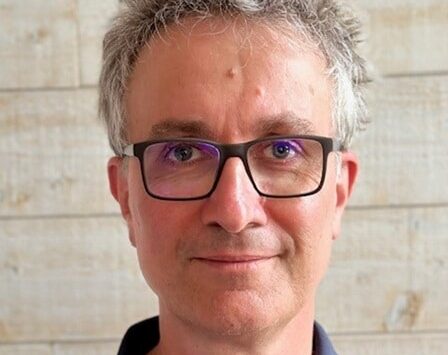
Bruno closes the interview with four principles he calls the axioms of his field:
A1: PMICs for energy harvesting are power converters — they are not voltage or current converters like mainstream products.
A2: PMICs for energy harvesting interface an energy source, a storage element and an application.
A3: PMICs isolate the source power behaviour from the storage element behaviour from the application supply behaviour.
A4: PMICs for energy harvesting are optimized for fitting a vast ecosystem.